INTRODUCTION: CAN A DRUG “CHANGE ITS PROPERTIES” EVEN WHEN IT IS MANUFACTURED USING THE SAME FORMULATION AND PROCESS?
In pharmaceutical formulation, we often assume that two drug samples containing the same active pharmaceutical ingredient (API) with the same chemical formula should have essentially identical properties. However, this is not always true for compounds capable of forming crystals.
A single drug substance may exist in several different crystalline forms, a phenomenon known as polymorphism. These forms have the same chemical composition but differ in how their molecules are arranged within the crystal lattice. As a result, they may exhibit different solubility, dissolution rates, physical stability, melting points, and other physicochemical properties.
Ritonavir is one of the most well-known and classic examples of this phenomenon.
1. RITONAVIR – A WELL-KNOWN ANTIVIRAL DRUG
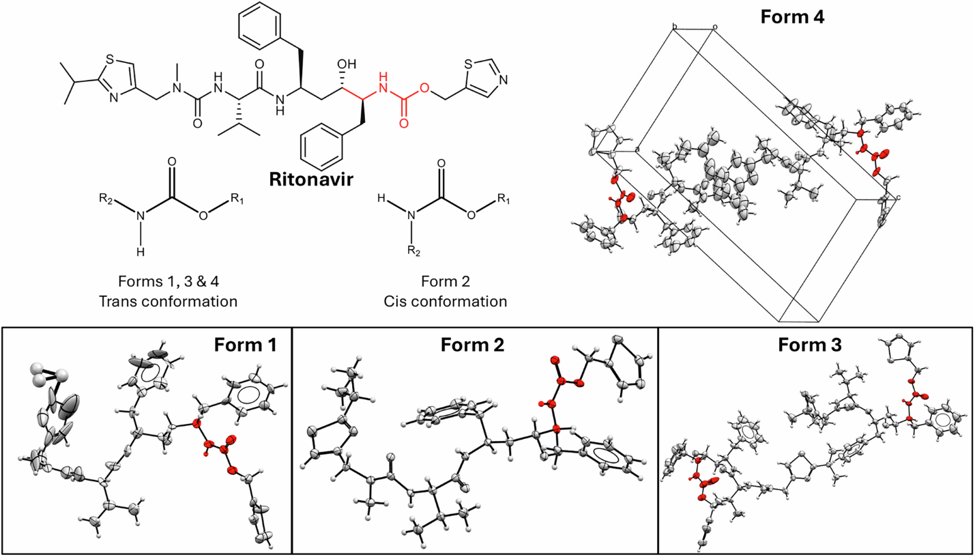
Ritonavir is an HIV protease inhibitor that was introduced to the market in 1996 under the brand name Norvir®. It is a relatively large molecule with considerable conformational flexibility, containing multiple bonds that can rotate freely.
During the early stages of development, researchers identified one crystalline form of ritonavir, known as Form I. This form was selected for product development and considered suitable for the formulation at that time.
Everything appeared to be under control.
However, in 1998, an unexpected problem emerged.
2. THE UNEXPECTED INTRUDER: A NEW CRYSTAL FORM EMERGES DURING MANUFACTURING
In the summer of 1998, manufacturers discovered a new crystalline form of ritonavir emerging within the production system. This new form was designated Form II.
Importantly, Form II was not a conventional chemical impurity. It was still ritonavir, with exactly the same chemical formula and molecular structure. The only difference was how the ritonavir molecules were arranged within the crystal lattice.
Yet, this seemingly minor difference had enormous consequences.
Form II was significantly less soluble than Form I. When Form II appeared in the product, the dissolution rate of ritonavir decreased, and the product could no longer meet the required dissolution specifications.
In other words, the drug substance was still present, but it could no longer dissolve and release the active ingredient as required.
Subsequent studies demonstrated that Form II was thermodynamically more stable than Form I. Consequently, once Form II appeared, it had the potential to become the predominant crystalline form.
3. THE REAL PROBLEM: FORM II WAS MORE STABLE THAN FORM I
This was the critical turning point in the story.
If Form II had been both less soluble and less stable than Form I, the problem might have been relatively straightforward to resolve. However, the opposite was true: Form II was thermodynamically more stable.
This meant that, under suitable conditions, the system naturally tended to transform towards Form II.
Once formed, Form II crystals could act as seeds, promoting further crystallization of the same form. These seeds could contaminate the manufacturing environment through equipment surfaces, airborne particles, or even workers' clothing.
Once introduced into the environment, they could trigger the solid-state phase transformation from Form I to Form II, helping explain why Form I effectively disappeared from the production process.
This phenomenon became widely known as “disappearing polymorphism” or the disappearing polymorph phenomenon.
Form I had originally been relatively easy to produce during drug development. However, after Form II emerged, obtaining Form I again became extremely difficult.
Form I had not literally disappeared. Rather, it had become increasingly difficult to manufacture because the system favored the formation of the more thermodynamically stable form, Form II.
Later investigations revealed that ritonavir could exist in several different solid-state forms, with the well-known Form I/Form II transformation representing only part of a much more complex polymorphic landscape.
4. WHY DOES THIS MATTER IN DRUG DEVELOPMENT AND MANUFACTURING?
For poorly water-soluble drugs, solubility and dissolution rate can become critical factors limiting oral bioavailability.
A crystalline form with a more stable lattice generally requires more energy to disrupt when exposed to a dissolution medium. This can make dissolution more difficult and slower.
The process can be illustrated as follows:
Crystal → Crystal lattice disruption → Molecules enter solution → Absorption
When the crystal lattice is too stable:
Crystal → Difficult lattice disruption → Slower dissolution → Reduced amount of drug available for absorption
In the case of ritonavir, the emergence of Form II significantly reduced the drug substance's ability to dissolve, resulting in failures to meet dissolution test specifications.
This was not simplya problem concerning the chemistry of the raw material. It became a challenge affecting the quality and performance of the entire drug product.
5. A VALUABLE LESSON IN QUALITY BY DESIGN (QbD), EVEN BEFORE QbD BECAME WIDELY ADOPTED
The ritonavir case offers an important lesson for pharmacy students and pharmaceutical scientists:
Understanding the chemical formula of an active pharmaceutical ingredient is not enough.
During drug development, several solid-state and physicochemical characteristics must also be carefully evaluated, including:
Polymorphic forms.
Amorphous forms.
Solvates and hydrates.
Molecular conformations.
Particle size.
Surface area.
Degree of crystallinity.
Solid-state stability.
The potential for solid-form transformations during manufacturing and storage.
In particular, when developing a drug substance with multiple crystalline forms, selecting the appropriate polymorph must go hand in hand with controlling the crystallization process.
Even relatively small changes in the following parameters can alter the crystalline form obtained:
Solvent selection.
Temperature.
Cooling rate.
Concentration.
Degree of supersaturation.
Presence of impurities.
Seeding conditions.
This is precisely why polymorph screening has become an essential part of the development of new pharmaceutical compounds.
Understanding and controlling polymorphism is not merely a matter of solid-state chemistry. It is fundamental to ensuring consistent drug quality, manufacturing reproducibility, and therapeutic performance.
REFERENCES
[1] Bauer, J., Spanton, S., Henry, R., Quick, J., Dziki, W., Porter, W., & Morris, J. (2001). Ritonavir: An extraordinary example of conformational polymorphism. Pharmaceutical Research, 18(6), 859–866.
[2] Chemburkar, S. R., Radich, G., Patel, B., Spiwek, H., Studelska, D. R., Robbins, G., ... & Bauer, J. (2000). Dealing with the impact of ritonavir polymorphs on the late-stage development and commercialization of Norvir® oral solution. Organic Process Research & Development, 4(5), 413–417.
[3] Dunitz, J. D., & Bernstein, J. (1995). Disappearing polymorphs. Accounts of Chemical Research, 28(4), 193–200.
[4] Morissette, S. L., Soukasene, S., Levinson, D., Cima, M. J., & Almarsson, Ö. (2003). High-throughput crystallization: Polymorphs, salts, co-crystals and solvates of pharmaceutical solids. Advanced Drug Delivery Reviews, 55(3), 261–300.
[5] Yao, Y., Ma, C. Y., Wang, C., Turner, T., & Roberts, K. J. (2023). Melt crystallization and structural characterization of a new ritonavir polymorph: Form IIIb. Crystal Growth & Design, 23(8), 5890–5901.
[6] Parent, S. B., et al. (2026). Crystal structure determination of Ritonavir Form IV via electron diffraction and its thermodynamic relationships. Crystal Growth & Design, 26(2), 1120–1132.
Authors:
MSc. Nguyễn Xuân Tú
MSc. Nguyễn Yên Hà
Publication date: October 31, 2026

